
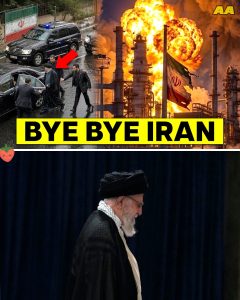
Iran’s growing crisis is no longer just a military standoff, but a deepening political and economic emergency that could reshape the entire region.
For decades, Iran’s ruling establishment built its identity around resistance, self-reliance, and the claim that it could survive any pressure from the outside world.
That message was repeated in speeches, state media broadcasts, military parades, and political slogans designed to convince both supporters and enemies that the system would never bend.
But the latest pressure campaign has exposed a very different reality inside the country.
According to the claims outlined in the source material, Iranian officials are now facing a dangerous combination of economic strain, internal fear, public anger, and diplomatic isolation.
The most dramatic sign of that pressure came when Iran’s foreign minister traveled to Russia for urgent talks with Vladimir Putin.
For a government that has long presented itself as proud and independent, the image of Tehran seeking help from Moscow carried a powerful symbolic weight.
It suggested that Iran’s leadership may be searching for a lifeline at the very moment its economy is being squeezed from multiple directions.
The reported naval blockade has become the center of this crisis.
The blockade is described as targeting ships traveling to and from Iranian ports, limiting Iran’s ability to move exports and receive imports.
That matters because Iran depends heavily on trade routes through the Strait of Hormuz and surrounding waters.
When exports are slowed or blocked, government revenue suffers.
When imports are disrupted, food supplies, industrial needs, and ordinary consumer markets can all come under pressure.
The result is a painful double blow.
Money stops coming in.
Goods stop coming in.
Prices rise.
Jobs disappear.
Public frustration grows.
The source material claims that Iranian ports and nearby waters are becoming crowded because tankers and ships can load cargo but cannot freely move beyond the blockade line.
This creates a visible sign of economic paralysis.
Ships may be present, but trade is not moving normally.
Oil may be loaded, but customers may not receive it.
For a government already facing sanctions, currency problems, and public distrust, this kind of disruption can become explosive.
Iranian officials reportedly fear that economic hardship could trigger renewed protests.
That fear is not difficult to understand.
When prices rise, unemployment expands, and daily life becomes harder, political anger often moves from private conversations into the streets.
The source material says Iranian security agencies have warned that public protests may become inevitable, with the only uncertainty being when they might begin.
That is a chilling assessment for any regime.
A government can prepare for a foreign enemy.
It can build missiles, deploy forces, and negotiate with allies.
But when its own population becomes the greatest source of fear, the crisis changes completely.
Another major pressure point is the reported internet shutdown.
The source claims that most Iranians have been cut off from normal internet access for more than two months.
Such a shutdown would not only isolate the public from the outside world, but also damage the modern economy.
Online workers, small businesses, digital services, and private companies all depend on connectivity.
If millions of people cannot work, communicate, sell, buy, or organize normally, the economic pain becomes even sharper.
But the political purpose is obvious.
An internet shutdown makes it harder for protesters to coordinate.
It makes it harder for images of unrest to spread.
It makes it harder for the world to see what is happening inside the country.
That does not mean anger disappears.
It only means anger is trapped under pressure.
And pressure, when contained too long, can erupt without warning.
This is why the Russia meeting matters.
Iran has supported Russia in recent years, especially through drones and military cooperation.
Now, according to the source material, Tehran appears to expect Moscow to return the favor.
But Russia has its own problems, especially the ongoing war in Ukraine.
That limits how much help Moscow can realistically provide.
Putin may offer words, coordination, intelligence support, or diplomatic backing.
But whether Russia can truly rescue Iran from economic suffocation is another question entirely.
The meeting reportedly lasted for two hours behind closed doors.
That secrecy has fueled speculation about what was discussed.
Military support.
Economic relief.
Intelligence sharing.
Future moves if the conflict restarts.
No one outside those rooms can know for certain.
But the fact that security officials were reportedly involved suggests that the conversation may have gone far beyond polite diplomacy.
Meanwhile, oil storage has become another urgent concern.
If Iran cannot export enough oil, storage facilities eventually fill up.
Once storage fills, production may have to slow.
That would strike directly at one of the country’s most important sources of income.
The source material cites estimates suggesting Iran may have only a limited number of days before unused storage becomes a serious problem.
Whether the exact number is 12 days, 22 days, or somewhere in between, the larger point remains the same.
A country built around oil exports cannot absorb a prolonged blockage without serious consequences.
At the diplomatic level, Iran is reportedly trying to submit revised proposals through mediators.
But the central problem remains nuclear negotiations.
According to the source material, the United States is not interested in separating the blockade issue from Iran’s nuclear program.
From Washington’s perspective, the nuclear question is the reason the confrontation exists in the first place.
That means Iran may be trying to negotiate relief from immediate economic pressure while delaying the hardest political concessions.
For the United States, that may look like an attempt to escape the crisis without addressing its root cause.
For Iran, it may be a desperate attempt to buy time.
This is where the internal leadership question becomes even more important.
The source material describes confusion and uncertainty surrounding Iran’s supreme leadership.
There are claims of injury, questions about public absence, and doubts about who is truly making decisions.
In any authoritarian system, uncertainty at the top can be dangerous.
Rival factions may compete.
Security agencies may act independently.
Diplomats may struggle to negotiate clearly.
Military commanders may push for escalation while economic officials push for relief.
That kind of fractured leadership can make a crisis harder to solve.
The most dangerous possibility is miscalculation.
A government under pressure may take bigger risks.
It may threaten shipping lanes.
It may attack regional targets.
It may use military escalation to distract from domestic weakness.
But each risky move can bring heavier retaliation and deeper isolation.
That is the trap Iran appears to be facing in this narrative.
The more pressure builds, the more the regime needs a way out.
But the more aggressively it searches for leverage, the more dangerous the crisis becomes.
For ordinary Iranians, the consequences are far more personal.
They are not debating strategy in closed rooms.
They are dealing with rising prices, job losses, internet restrictions, uncertainty, and fear.
They are watching leaders who once promised strength now look abroad for help.
They are seeing a political system that appears more focused on survival than on daily life.
That disconnect may become the greatest threat of all.
Regimes often survive sanctions.
They often survive military pressure.
They sometimes even survive diplomatic isolation.
But when people stop believing the system can protect their future, the foundations begin to crack.
Iran’s crisis is therefore not only about ships, oil, Russia, or nuclear talks.
It is about legitimacy.
It is about whether a government that built itself on resistance can survive a moment when resistance begins to look like desperation.
It is about whether fear can keep people silent when hunger, unemployment, and isolation become impossible to ignore.
And it is about whether foreign allies can save a regime from problems created inside its own borders.
The coming weeks could prove decisive.
If the economic pressure continues, Iran may be forced to choose between deeper escalation and painful compromise.
If protests return, the leadership may face a domestic crisis far more dangerous than any foreign blockade.
If Russia cannot deliver meaningful help, Tehran may discover that its most important alliance is weaker than it hoped.
For years, Iran’s rulers told the world they could stand alone.
Now, the world is watching to see whether that slogan was strength, or just a mask cracking under pressure.
