
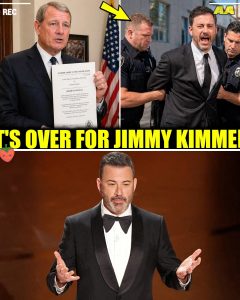
A late-night joke about Melania Trump has erupted into a political firestorm, turning Jimmy Kimmel into the center of a national debate over comedy, rhetoric, accountability, and the limits of what television networks should tolerate.
https://www.youtube.com/watch?v=1xqeRMK6Wys
The controversy began with a monologue that critics say crossed far beyond ordinary political satire.
In the segment described in the source material, Kimmel reportedly joked that Melania Trump had the “glow of an expectant widow,” a line that immediately triggered outrage among Trump supporters and conservative commentators.
To critics, the remark was not simply sharp comedy.
It sounded cruel, reckless, and disturbingly close to language that treats political violence as entertainment.
The backlash intensified after Melania Trump publicly condemned the joke and called on ABC to take action.
Her response framed the comment as part of a broader culture of hateful rhetoric that, in her view, deepens division inside America.
That statement turned the controversy from another late-night television dispute into a larger political confrontation.
Suddenly, the question was no longer whether the joke was funny.
The question became whether a major network should continue giving a platform to language critics believe normalizes hostility against public figures and their families.
Supporters of Melania argued that Kimmel’s joke was especially disturbing because it invoked widowhood, death, and the possibility of a president’s assassination.
They said there is a difference between mocking a politician and joking about a spouse becoming a widow.
That distinction became the emotional center of the controversy.
For many viewers, the remark felt less like comedy and more like a symptom of a media culture that rewards shock over responsibility.
Several conservative voices cited in the source material argued that ABC and Disney have protected Kimmel while punishing others for far less.
Sage Steele, a former ESPN and Disney employee, was presented as one of the strongest critics.
She argued that Disney has a history of enforcing speech rules selectively, depending on whether the speaker fits the preferred political narrative.
Her criticism added another layer to the story.
This was no longer only about one joke.
It became about corporate hypocrisy, network accountability, and whether entertainment companies apply their standards evenly.
Lara Trump also criticized the remarks, saying that comedy has lost its ability to entertain when it depends on dark political attacks.
Her message was simple.
If a comedian must reference death or tragedy to get attention, then the act has already failed.
That argument resonated with viewers who believe late-night television has shifted from humor into political obsession.
The source material also claims that legal and regulatory pressure could now surround the controversy.
It includes dramatic references to federal courts, the Supreme Court, broadcast licenses, and possible consequences for Kimmel and ABC.
Those claims should be treated cautiously as part of the provided narrative, not as verified legal fact.
Still, they reflect a growing demand among critics for something stronger than public criticism.
They want consequences.
They want ABC to discipline or remove Kimmel.
They want the FCC to examine whether public airwaves are being used responsibly.
They want advertisers and affiliates to reconsider the cost of supporting content they view as toxic.
The broadcast license argument is especially important to the political drama.
Critics argue that major networks do not operate like ordinary private speakers because they benefit from access to public airwaves and powerful distribution systems.
From that perspective, they say networks have a duty to avoid programming that inflames political hostility or targets families in dangerous ways.
Defenders of late-night comedy would likely respond that satire must remain protected, especially when aimed at powerful public figures.
But the controversy shows how difficult that balance has become.
In a calmer political era, a harsh joke might fade after a day of outrage.
In today’s America, every phrase is pulled into a larger battle over violence, media bias, censorship, free speech, and double standards.
That is why this story has gained so much attention.
It sits at the intersection of celebrity, politics, comedy, network power, and national fear.
The emotional force of the backlash comes from a belief that words no longer stay on television screens.
Critics argue that repeated violent imagery and dehumanizing jokes can shape the mood of unstable people.
They point to a culture where political opponents are treated as enemies rather than fellow citizens.
They fear that entertainment has become another weapon in that atmosphere.
Whether one agrees with that argument or not, the anger is real.
Melania Trump’s decision to speak publicly made the controversy even harder for ABC to ignore.
First ladies often choose restraint, especially when facing jokes and media criticism.
But in this case, Melania’s statement was direct, personal, and accusatory.
She did not merely say the joke offended her.
She said it reflected something corrosive in American political life.
That wording matters because it transforms the complaint from personal insult into national warning.
ABC now faces a complicated choice.
If the network stands by Kimmel, critics may accuse it of enabling hateful rhetoric.
If it disciplines him, free-speech advocates may accuse it of surrendering to political pressure.
If it stays silent, the story may continue growing as commentators, politicians, and viewers fill the silence with their own conclusions.
For Kimmel, the controversy adds to a broader perception among critics that his comedy has become too consumed by anti-Trump material.
The source material repeatedly claims that he has moved from humor into obsession.
That is a powerful accusation because late-night comedy depends on audience trust.
A host can be partisan and still funny.
But once viewers see the performance as bitterness rather than wit, the jokes begin to sound like lectures.
That is the danger for any comedian in a polarized country.
The audience may stop laughing and start judging the motive.
The most dramatic claim in the provided narrative is that Kimmel could be forced to resign or face severe legal consequences.
Again, those claims should not be presented as confirmed fact.
But their presence shows how far the controversy has escalated in the political imagination.
For his strongest critics, resignation is not enough.
They want the moment to become a turning point for American media.
They want networks to understand that jokes about death, violence, and political families can no longer be dismissed as edgy monologues.
At its core, this story is about power.
Kimmel has the power of a national platform.
ABC has the power to decide what enters millions of homes.
Melania Trump has the power to turn personal outrage into a public challenge.
Viewers have the power to reward or punish the network with attention, ratings, and pressure.
And in the middle of it all is one sentence that critics believe exposed a much deeper sickness in modern political entertainment.
The final question is not only whether Jimmy Kimmel went too far.
It is whether America’s media culture still knows where the line is.
Because when comedy begins to sound like contempt, and outrage becomes the business model, the punchline may no longer be the most important part of the show.
The real story may be what the audience is willing to accept next.
