
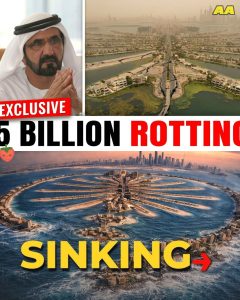
The Palm Jumeirah was once sold as Dubai’s impossible dream, but behind the glittering villas and billionaire headlines, a quieter and more troubling story may now be emerging.
For years, the Palm Jumeirah stood as one of the most recognizable symbols of modern luxury in the world.
It was not just an island.
It was a statement.
It told investors, tourists, celebrities, and governments that Dubai could bend the sea itself into the shape of ambition.
From above, the island looked like a masterpiece of engineering confidence.
From the beach, it looked like a paradise built for people who wanted privacy, status, and a waterfront address no one could ignore.
But a growing question now hangs over the world-famous development.
What happens when the image stays perfect, but the foundation beneath the image begins to tell a different story?
According to the source material, a photograph circulated on a Dubai property forum in early 2025 showing the underside of a villa on the Palm.
It was not the polished side seen in real estate brochures.
It was not the infinity pool view sold to global buyers.
It was concrete, cracks, exposed reinforcement, and waterlogged joints near the sea.
The image did not become a global scandal.
It was dismissed by some as isolated, exaggerated, or driven by angry residents.
Yet the deeper concern was not one damaged villa.
The deeper concern was whether the Palm’s prestige market has started to collide with long-term maintenance realities.
The Palm Jumeirah was completed in phases between 2006 and 2010, which means many of its villas are still less than two decades old.
In ordinary luxury real estate, that is not old.
But the Palm is not ordinary real estate.
It sits in the Arabian Gulf, a hot, salty, aggressive marine environment that places enormous stress on concrete, steel, joints, and coastal structures.
Saltwater does not care about branding.
Humidity does not respect wealth.
Structural fatigue does not pause because a villa has a famous address.
That is why the Palm’s next chapter may be less about glamour and more about maintenance, liability, and trust.
For years, buyers believed the island’s story would remain permanent.
That belief helped fuel record-breaking prices and global attention.
The Palm became a place where ultra-wealthy buyers parked capital, collected status, and joined one of the most photographed property markets on Earth.
But luxury markets depend on confidence.
Once confidence begins to soften, even slowly, the mood can change before the skyline does.
The source material argues that average transaction prices on the Palm’s residential fronds peaked in mid-2023 and have softened since.
This does not mean the island is collapsing.
It does not mean prices are crashing overnight.
But it may signal divergence.
Other ultra-prime areas in Dubai are reportedly showing stronger growth, better access, newer finishes, and fewer doubts about structural maintenance.
That matters because buyers at the top of the market have choices.
They can choose newer waterfront projects.
They can choose communities with easier roads.
They can choose properties without the same questions about marine exposure and remediation costs.
The Palm’s greatest asset has always been its uniqueness.
But uniqueness can become a burden if it also means higher inspection costs, complex repairs, and shared infrastructure pressures.
The article’s most striking concern is the level of nonoccupancy.
If a significant share of villas are not used as primary homes, active rentals, or consistently maintained properties, the island begins to face a different type of risk.
Empty luxury homes may look harmless from the outside.
But deferred maintenance can turn small problems into expensive ones.
On a man-made island, neglect can become far more costly than it would be in a normal neighborhood.
A villa on the Palm is not just a private house.
It is part of a larger system exposed to saltwater, traffic pressure, marine access issues, and collective maintenance demands.
That creates a difficult contradiction.
The island needs collective care.
But its ownership base may be fragmented, international, absentee, and motivated by different priorities.
Some owners live there and maintain their homes carefully.
Some treat the property as a seasonal residence.
Some treat it as a financial asset.
Some may delay repairs because they do not feel the daily consequences.
The sea, however, works every day.
It does not wait for owners to return from London, Moscow, Mumbai, or Geneva.
For the ultra-wealthy, these problems may remain manageable.
Owners with estate managers, engineering consultants, and full-time maintenance teams can inspect, repair, and upgrade before visible damage becomes severe.
For them, the Palm’s challenges may simply become another cost of luxury ownership.
But for the middle layer of buyers, the situation could be far more painful.
A family that bought a villa as a retirement plan, rental investment, or dream second home may not be prepared for a major structural remediation bill.
A property once expected to appreciate effortlessly may suddenly carry hidden risk.
That is the moment when prestige becomes pressure.
The human side of the story is even more overlooked.
The Palm depends on maintenance staff, security workers, property managers, cleaners, drivers, hospitality teams, and domestic workers.
These workers keep the luxury image alive, yet they rarely appear in glossy real estate reports.
If owners begin cutting costs, delaying contracts, or switching to cheaper service providers, these workers feel the impact first.
The decline of a prestige product is not always dramatic.
Sometimes it begins with fewer hours, lower standards, delayed repairs, and invisible labor being squeezed harder.
That is the uncomfortable truth behind many luxury markets.
The people who keep the dream polished are often the first to suffer when the dream becomes expensive to maintain.
The Palm Jumeirah is not sinking.
That distinction is important.
The issue is not whether the land will disappear tomorrow.
The issue is whether the island can continue to justify the massive price premium attached to its name.
That premium was built on a story of permanent desirability.
It was built on the idea that the Palm would always be the Palm, always rare, always iconic, always worth more.
But real estate value is not only about location.
It is also about confidence, access, maintenance, liquidity, and future cost.
If buyers start pricing in structural uncertainty, traffic frustration, absentee ownership, and higher repair bills, the magic number changes.
Dubai has survived property shocks before.
After the 2009 downturn, the city rebuilt its real estate market and returned stronger in many ways.
So the Palm’s future is not doomed.
A serious maintenance program, stronger oversight, better owner coordination, and transparent inspection standards could protect the island’s value.
The question is whether that response arrives before the market fully prices in doubt.
Because once doubt enters luxury real estate, it can be difficult to remove.
The Palm Jumeirah remains extraordinary.
It remains famous.
It remains one of the boldest real estate projects ever built.
But its next test may not be whether Dubai can dream big.
Dubai has already proven that.
The next test is whether a dream built in the sea can age with discipline, transparency, and responsibility.
For investors, the lesson is clear.
Do not buy only the postcard.
Look beneath the villa.
Ask about the concrete, the maintenance history, the occupancy pattern, the repair costs, and the long-term governance model.
Because the future of the Palm may depend less on what it looks like from the sky and more on what is happening quietly underneath.
