
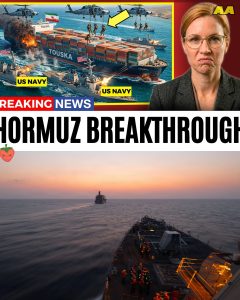
An Iranian cargo ship’s refusal to turn back in the Arabian Sea has become a dramatic new symbol of the escalating naval standoff between Tehran and Washington.
The confrontation began when the MV Tusca, a massive Iranian-flagged cargo vessel, continued moving toward Bandar Abbas despite repeated warnings from a United States Navy destroyer.
The ship was not a small patrol craft or a military boat.
It was a 275-meter commercial giant carrying containers across the Arabian Sea, moving directly toward a blockade line it had been ordered not to cross.
For hours, the USS Spruance tracked the vessel, issued warnings, and gave its crew multiple chances to change course.
The message was clear.
Turn around, comply with the blockade, or face disabling action.
The Tusca did not respond.
It kept moving.
That silence turned a tense maritime encounter into one of the most dramatic naval moments of the crisis.
According to the source material, the United States had been enforcing a strict maritime interdiction operation since April 13, targeting vessels entering or leaving Iranian ports.
By the time the Tusca approached the restricted zone, dozens of other ships had reportedly chosen to turn back.
The Tusca became the exception.
That decision placed it directly in the path of American naval power.
The USS Spruance, an Arleigh Burke-class guided missile destroyer, was equipped for far more than simple patrol duty.
With advanced radar, missiles, torpedoes, and a powerful five-inch naval gun, the destroyer represented the kind of force no commercial vessel could realistically challenge.
Still, the Tusca maintained its course.
For six hours, the Navy repeated its warnings across multiple channels.
Each transmission was logged.
Each warning built the record that the ship had been given every opportunity to avoid escalation.
Then the tone changed.
The Tusca was ordered to vacate its engine room.
That phrase signaled that the next step would not be another warning.
It would be disabling fire.
At 20:22 local time, the USS Spruance opened fire on the ship’s engine room.
The goal was not to sink the Tusca.
The objective was to stop it.
The rounds struck the propulsion area and disabled the massive cargo vessel.
Within moments, the ship that had been moving toward Iranian waters slowed and stopped dead in the Arabian Sea.
The confrontation was no longer about whether the blockade could be challenged.
It was about who would take control of the ship next.
That task fell to U.S. Marines launched from the USS Tripoli.
Two MH-60 Seahawk helicopters approached the disabled vessel in darkness.
Marines fast-roped onto the deck in full combat gear, secured the bridge, cleared key compartments, and confirmed the engine-room damage.
The boarding operation reportedly took less than ten minutes.
The Tusca was now in U.S. custody.
The symbolic power of the seizure was enormous.
It showed that the blockade was not merely political language.
It was an active military operation with real consequences.
It also revived memories of 1988, when U.S. naval forces clashed with Iran in the Persian Gulf during Operation Praying Mantis.
That earlier confrontation sent a brutal message about American willingness to protect navigation and respond to threats in the region.
The Tusca incident carried a similar warning in a modern form.
If Iran or any sanctioned vessel tried to test the blockade, the response would be fast, documented, and overwhelming.
Iran’s reaction was predictable.
State media denounced the seizure.
Officials threatened retaliation.
The familiar warning about oil markets and the Strait of Hormuz returned almost immediately.
But the Tusca episode revealed the difference between making threats and confronting a destroyer at sea.
In narrow waters, Iran can use fast boats, mines, missiles, and asymmetric pressure.
In open water against a U.S. Navy destroyer, the balance looks very different.
The ship’s seizure also came at a sensitive diplomatic moment.
Peace talks were already fragile.
Iran reportedly refused to send negotiators while the blockade remained in place.
The ceasefire atmosphere weakened, and the Persian Gulf returned to a dangerous cycle of threat, response, and global anxiety.
That anxiety matters because the Strait of Hormuz is not just another waterway.
A major share of the world’s oil supply passes through that narrow maritime corridor.
Every confrontation there sends shockwaves through energy markets, shipping routes, and diplomatic capitals.
That is why the seizure of one cargo ship became more than a military event.
It became a message to Tehran, Beijing, Moscow, shipping companies, oil markets, and every government watching the crisis unfold.
The message was blunt.
A U.S. naval blockade is not symbolic.
It will be enforced.
The Tusca also showed the precision of modern maritime operations.
The destroyer did not destroy the vessel.
It disabled it.
The Marines did not storm blindly.
They boarded quickly, secured the ship, and took control with discipline.
That distinction matters.
The operation was designed to project power without creating unnecessary chaos.
It was force with a clear purpose.
For Iran, the incident creates a painful dilemma.
If it continues to challenge the blockade, it risks more seizures and deeper humiliation.
If it backs down, it appears weak at home and abroad.
If it escalates against commercial shipping, it may invite even stronger international pressure.
Every choice carries danger.
For the United States, the operation reinforces deterrence.
It tells adversaries that warnings will be followed by action.
It tells allies that the Navy can still control critical sea lanes.
It tells shipping networks that the blockade has teeth.
Yet the risk of miscalculation remains high.
One ship was stopped.
One boarding succeeded.
But every new encounter creates another chance for escalation.
A mistaken move, a misread warning, or a nervous commander could turn a controlled seizure into a wider conflict.
That is the true danger of the Persian Gulf crisis.
The Tusca may be only one ship, but it now stands as a 275-meter warning floating inside a much larger confrontation.
Its captain made a choice.
The Navy answered.
The world watched.
And the next vessel approaching the blockade line will understand exactly what that choice can cost.
